Showing posts with label 1988. Show all posts

Tuesday, June 7, 2016

Jun. 7, 1988: Dukakis Clinches Nomination

California Primary --- Dukakis 61%,  Jackson 35%

Jackson Vows to Continue Campaigning,  Chicago Tribune


California primary official results for June 7, 1988.

"One of the most exciting and significant political developments of the Twentieth Century" --- Bernie Sanders, mayor of Burlington, Vermont. (source). 


Apr. 20, 1988


Bernie Sanders, Mayor of Burlington, Vermont, becomes one of the only elected officials in the nation to endorse the Rev. Jesse Jackson for President


Mar. 16, 1988

...Simon Wins Illinois Primary Over Jackson and Dukakis
New York Times

Feb. 17, 1988


...Dukakis Is Easy Winner In New Hampshire Primaries

New York Times

Feb. 10, 1988

 ...Simon Seen as Hobbled By Iowa's Voting

Feb. 8, 1988


Dick Gephardt wins Iowa caucus over Paul Simon and Michael Dukakis


Oct. 10, 1987

Jesse Jackson announces he will seek Democratic nomination for President  


C-SPAN video


Sept. 25, 1987  


Biden Bites the Dust

Toledo Blade


"You Won't Have Joe Biden to Kick Around Any More." (cf. Richard Nixon 1962).


Sept. 24, 1987

Biden drops out with 'incredible reluctance', Bangor Daily News
 

Sept. 18, 1987

Biden Admits Plagiarism in School But Says It Was Not 'Malevolent' 
(New York Times)

Sept. 9, 1987 

Gary Hart admits adultery, won't run for presidential seat


Jun. 18, 1987, The Argus-Press

Donna Rice Won't Say If She Slept With Hart,


May 8, 1987, The Spokesman-Review

Gary Hart withdrawal leaves Democratic race 'wide open'


Apr. 29, 1987


Michael Dukakis announces he is seeking Democratic Nomination, in Manchester, N.H.

(C-SPAN video)

Feb. 23, 1987, Christian Science Monitor


Cuomo's 'no' opens door for dark horses


Dec. 29, 1986,  Lawrence Journal-World

Iowa Democrat Poll Picks Hart

Gary Hart 56 % -- Mario Cuomo 13% 


Mar. 19, 1986,  Bangor Daily News

Rep. Gephardt is dark horse for 1988 Democratic nomination


Apr. 25, 1985


 Democrats Think They See A Better Horse for '88 Race


Nov. 6. 1984: Reagan 525, Mondale 13

Mondale crushes Reagan in the District of Columbia

Mondale: 180,408 (85.38%)
Reagan: 29,009 (13.73%)


and wins Minnesota by 3761 votes out of two million.

Mondale: 1,036,364 (49.72%)
Reagan:   1,032,603 (49.54%)


wikipedia

On the radio

  "Passion burns you like never before..."

Billboard Top 10 for week ending Nov. 3, 1984

In theaters nationwide...

"They came to fight...for the one woman who could save their future..."


Monday, June 6, 2016

Jul. 19, 1984: Mondale Accepts Nomination at the Moscone Center in San Francisco

On the Fourth night of the convention

Frtiz at the podium

 "Budgets will be squeezed...Taxes will go up."


Background going into convention: After the California primary, Hart had won more states, but Mondale had edged him out in the popular vote.

1984 Popular Vote totals in all Democratic primaries

Mondale: 6,952,912 (38.3%) (19 states + DA, PR)
Hart:        6,504,842 (35.9%) (26 states)
Jackson:  3,282,431 (18.1%) (2 states + DC)


Earlier in evening

the audience witnessed the history-making speech by Geraldine Ferraro, a Congresswoman from Queens.

The Prosecutor:

"If you break the law, you must pay for your crime"

Our faith that we can shape a better future is what the American dream is all about. The promise of our country is that the rules are fair. If you work hard and play by the rules, you can earn your share of America's blessings. Those are the beliefs I learned from my parents. And those are the values I taught my students as a teacher in the public schools of New York City.
At night, I went to law school. I became an assistant district attorney, and I put my share of criminals behind bars. I believe if you obey the law, you should be protected. But if you break the law, you must pay for your crime.

Jul. 18, 1984

On the previous night

Speech by second-place finisher Gary Hart

(cf. Hart's offer to Jackson the night before the convention)


Democrats are..."the Party of Experimentation...we'll try some thing else"

Our party's greatest heritage is its willingness to change. We have failed when we became cautious and complacent. We have won America's confidence when we were bold and innovative. The Party of Experimentation.

Our party's great experimenter, Franklin Roosevelt, said it best at a critical hour at the dawn of his Presidency. He said: ''We will try something, and if it works we will keep it. If it doesn't, we'll try some thing else.''

... Tonight the torch of idealism is lit in thousands of homes and tens of thousands of towns and hundreds of thousands of lives, among the young in spirit and the young in age. It cannot go out. It will not go out. It will continue to burn.


 and third-place finisher Jesse Jackson 

America as quilt...

I ask for your vote on the first ballot as a vote for a new direction for this Party and this nation -- a vote of conviction, a vote of conscience. But I will be proud to support the nominee of this convention for the Presidency of the United States of America. Thank you...
America is not like a blanket -- one piece of unbroken cloth, the same color, the same texture, the same size. America is more like a quilt: many patches, many pieces, many colors, many sizes, all woven and held together by a common thread. The white, the Hispanic, the black, the Arab, the Jew, the woman, the native American, the small farmer, the businessperson, the environmentalist, the peace activist, the young, the old, the lesbian, the gay, and the disabled make up the American quilt.

Even in our fractured state, all of us count and fit somewhere. We have proven that we can survive without each other. But we have not proven that we can win and make progress without each other. We must come together. Jesse Jackson (source)


Jul. 16, 1984

Opening night, the speech that stuck in people's minds.

A Democratic star is born. All the postmodern intellectual appeal of Gary Hart, but with a warm fatherly compassion and old school Democratic working class appeal...the recently-elected Governor of New York...

Gov. Mario Cuomo of New York, just a year and half after taking office, vaults to national prominence with keynote address

America as wagon train...


It's an old story. It's as old as our history. The difference between Democrats and Republicans has always been measured in courage and confidence. The Republicans -- The Republicans believe that the wagon train will not make it to the frontier unless some of the old, some of the young, some of the weak are left behind by the side of the trail. "The strong" -- "The strong," they tell us, "will inherit the land."
We Democrats believe in something else. We democrats believe that we can make it all the way with the whole family intact, and we have more than once. --- Mario Cuomo


The Moscone Center was initially built in 1981 by architects Hellmuth, Obata & Kassabaum as one single hall, Moscone South, and named after San Francisco former mayor George Moscone, who was assassinated in November 1978.

Jun. 5, 1984: Hart Wins Big in California, Mondale Short of Clincher

 Ocala Star-Ledger


Flashback, three months earlier

Mar. 11, 1984

No longer a long shot: Gary Hart
 Eugene Register-Guard


later that evening,"Where's the Beef?" Mondale puts Hart on defensive in televised debate

Feb. 28, 1984

Democratic Presidential Race Thrown into Chaos With Gary Hart Victory in New Hampshire over Heavily Favored Walter Mondale

Monday, May 16, 2016

May 12, 1988: Bush Anointed


New York Times, May 12, 1988
Finally Robertson called it quits after the West Virginia and Nebraska primaries on May 10. The next day he announced he was pulling out before the Oregon primary on May 17. The last gadfly was gone. Robertson had been an annoyance but had fought as if his historical reputation depended on the result. In the end, even Bush could respect that.

1988 Republican primary results for the first two weeks of May. First column is Bush, second is Dole, third is Robertson, fourth is Jack Kemp, and fifth is Pierre du Pont.

Reagan wasted no time in endorsing Bush. The Gipper had played the whole primary process like a competition of the strongest,Now he was stepping in like an impartial contest judge to preside over the victory. His after-the-fact endorsement was like raising the fist of the last man standing in an open brawl while the others are lying face down in the mud. No one had to announce who the champion was.

Soon it's good-bye, old man, Bush said to black-and-white photograph of Reagan on the newspaper page he was holding.

Turns out I didn't need your blessing after all.

He read in the article:

...analysts say, no endorsement will cure the basic problem facing the Bush campaign: the lack of public perception that the Vice President has an identity independent of his role in the Reagan White House.

"Analysts," Bush sputtered with contempt. "Public perception,"

"Never mind that now. They can write what they want. Bush isn't President yet, but from now on, it's going to be the Bush story."


May 14, 1988 – Atlantic Records stages a concert at Madison Square Garden celebrating its Fortieth birthday with performances by many of the label's greatest acts of the past. Artists include Crosby, Stills & Nash, Iron Butterfly, Ruth Brown, Foreigner and Wilson Pickett, but the most talked-about performance is by a reunited Led Zeppelin with Jason Bonham on drums." (wikipedia)
(link to video) Wikipedia: 'Atlantic's first batch of recordings were issued in late January 1948, and included Tiny Grimes' "That Old Black Magic" and "The Spider" by Joe Morris In its early years Atlantic focused principally on modern jazz although it released some country and western and spoken word recordings. Abramson also produced "Magic Records" which were children's records with four different sets of grooves so each side had four different stories of which the story which got played was determined by where the stylus landed on the groove.'

Sunday, May 15, 2016

April 1988: Bush in Glory


. On April 11, 1988 at the 60th Academy Awards, The Last Emperor won all nine Oscars for which it was nominated, including Best Picture, as well as Best Director for Bernardo Bertolucci, who cowrote the screenplay. Wikpedia: "The film is a  epic biographical film about the life of Puyi, the last Emperor of China. The film opens in 1950, five years after the capture of Puyi by the Red Army. It then goes back to depict his ascent to the throne as a small boy to his imprisonment and political rehabilitation."
1988 NCAA Final Four semi-finals ticke for Sat. April 2, 1988t. Kemper Arena, Kansas City, Missouri. Finals were held on Mon., April 4.. Wikipedia: ."Kansas, coached by Larry Brown, won the national title with an 83–79 victory in the final game over Big Eight Conference rival Oklahoma, coached by Billy Tubbs. Kansas's upset was the third biggest point-spread upset in Championship Game history. After this upset, the 1988 Kansas team was remembered as 'Danny and the Miracles.'"  source

After Connecticut the Republican race was all over. Dole had fought hard as long as he could legitimately claim to be viable. He had withdrawn with honor and had given his endorsement at the end. By April, only Robertson still held out. His refusal to the step aside when he numbers dwindled marked his full transition from possible threat to a minor protest candidate. His recalcitrance in the face of obvious defeat smacked of disloyalty and would disqualify him from any future serious consideration within the Republican Party. 


Good riddance to the asshole, Bush must have thought, about the televangelist. His entire candidacy had been absurd. It had only served to weaken the party and give the idea to independents that it was overrun with nutty evangelicals. It played into the worst problems. Yet it also  underscored Bush's own manifest weakness at connecting with this segment of voters. To many of them, despite being Reagan's Vice President, he was an untrustworthy millionaire representing the Eastern elite.  

They will come to love me, he thought to himself.

Thankfully, the April primaries were now just a formality. Bush was the presumptive nominee. He could make the rounds of the primaries in semi-leisure, collecting his victories and solidifying his stature as a candidate of domination and strength. He must have been glad, almost delighted, to yield much of the media spotlight temporarily o Michael Dukakis, who throughout April was still plagued by an more-than-inconsequential protest candidacy of Jesse Jackson.

Dukakis was clearly going to win the nomination. Jackson didn't have a viable path at this point, but as the self-proclaimed and media-ordained leader of the nation's African-Americans, Jackson had an automatic credibility in staying in the race past the normal drop-out point, one that Robertson did not.  The Democratic Party couldn't force him out without looking terrible to the black community, which would cut deeply into their, and their philosophic idea of how politics should be run.

All in all, the situation was typical of the Democratic Party's historical inability to rally around a single standard bearer.

Thank god for the eleventh commandment, Bush must have thought. Speak no ill of fellow Republicans. By extension, you rally around the inevitable winner. Don't stay in just to knock him down. The Democrats kill themselves every time with infighting, and each time they swear they aren't going to do it.

Dukakis had done a better job than Mondale at least. He would not go down easily in the general election.

In the meantime, Bush was pleased to have the Massachusetts governor's energies devoted to this ongoing battle with Jackson. Hopefully it would last all the way to the Democratic convention, which ideally would be contentious and leave the party fractured. Meanwhile each week ticked off another headline: Bush wins again.

1988 Republican primary results for contests for late March and April.* Columns represent percentages of votes respectively for Bush, Dole, Robertson, Kemp, and du Pont. Only Bush and Robertson were still declared candidates at this point. From Wikipedia.  *Author note: New York results not represented here. Unavailable on Wikipedia and other sources, but they were considered of no consequence by then, and Bush would have won all the delegates.

Only last thing eluded him--the endorsement from one person that counted nearly as much as all the other votes so far, the man who had bested him in 1980, and whom he was determined one day to eclipse in greatness, not because his own ego required it, but because history inevitably would demand it. For all that to come, he still needed the Gipper.

Wikipedia: "President Reagan delivers a special address to Congress on the Program for Economic Recovery from the U.S. Capitol, April 28, 1981, a few weeks after surviving an assassination attempt."

March 1988: Conqueror Bush

,
Although recorded and released in 1987, Appetite for Destruction,
the debut album of Guns N' Roses would become arguably the most identifiable pop music backdrop to the year 1988. The MTV rotation in the spring of 1988 was dominated by the popular video for the single "Welcome to the Jungle," 

After the Maine caucus, word was out: Dole was broken. Within a week it would all be proven true.

Having made his singular stroke of history in Maine, Bush could get back to Reagan's playbook of conquest. Eight years before,  Reagan had beaten him badly in New Hampshire, but it was the South where Reagan had sealed his victory and had become the American Colossus, striding like a broad-shouldered giant across the region's primaries, and strangling any doubt that he was the anointed one to challenge Jimmy Carter.

Bush had spent eight long years for this moment to come, and now it would play out as he wanted.

The South was solid, but it demanded a strong leader, one it could unite behind. The South saw through the pretenders who were not up to the job of being President. The South would see Dole as the weak one, and Bush as the stronger. It would toss aside Robertson as a stereotype (the South knows preachers well and doesn't want them to go into politics. Such has typically been defect of thinking of the North and West). Kemp of course would be nothing but a curiosity to them, a former football player for a team they never each watched. Only Bush was the leader the South could depend on to be authentically American and strong.

This was the moment where eight long years in Reagan's shadow would pay off like a mature bond.

Pittsburgh Post-Gazette. March 30, 1988

First came the warm-up on March 5 in South Carolina, the state that was allowed by deep historical tradition going back to Calhoun to be the bellwether of the South.

Bush dominated there with 49%.  The results were a gut punch to Dole and a sign of bad things to come.

Three days later Super Tuesday Bush blew out the entire field from Virginia to Texas, and picked up more solid wins in New England. The final total: 16 states for Bush, many by massive landslides.  For Dole, zero. Robertson won Washington State---another kooky anomaly right at the end of the evening in the messianic Northwest. But Dole almost lost to Bush even there, for a distant second place.

The March 8 results were like a door slamming shut on the rest of the field, His goal had been to inspire doom in them, and he had pulled it off.

Dole's campaign was mortally wounded but he had to keep it going, almost out of a sense of pride to see it through. On March 15, he made his last real hopeful gasp in Illinois, Reagan's birthplace, which instead gave a solid 55% victory to Bush, echoing the South and putting to rest any doubt that Bush could win across the country.

Kemp saw the handwriting on the wall and soon dropped out, endorsing Bush as he left. Dole kept it going through Connecticut at the end of the month, almost as if to provide a bit of drama, and be the last one standing for the next election.

On March 29 the results from the Nutmeg State, the location of Bush's alma mater Yale, and the state that Bush's father had represented in the United States Senate, were a blunt message to Dole: "why are you still in the race? Bush is our man."

By the end of the evening, Dole had dropped out and endorsed Bush.

Wikipedia (public domain): "The arms of Yale University, often referred to as the shield of the university. The device on the seal, a book bearing the Hebrew phrase אורים ותמים (English: Urim V'Tamim), originates from the early eighteenth century, and its designer is unknown. The arms were illustrated from drawings by Fritz Kredel sometime before 1948. Additional information in Rogers, Bruce, and Lohmann, Carl A. (1948.) The Arms of Yale University and Its Colleges in New Haven. New Haven: Yale University Press. There is minimal innovation upon the pre-1923 design."


Prescott Sheldon Bush (1895-1972). United States Senator
from Connecticut In office
November 5, 1952 – January 3, 1963

Saturday, May 14, 2016

February 28, 1988: Bush at the Turning Point

Every great moment of history is unique in some way. Bush had followed successful playbooks so well, even through the long humiliation of being Reagan's useless sidekick. But now t it was failing him.

To win, he would need unique genius. He would need to go beyond the playbook, to something new that was pure Bush.

He had one ace to play---the upcoming caucus in his true home state of Maine, the location of the Kennebunkport family compound on the rocky coast.

Maine would come through for him. It would wake the nation. That was what Maine was about, after all---the steely rock-ribbed determination to save the Union when it was in its gravest danger, as it had been in July 1863 at Little Round Top at Gettysburg, when the famous downhill bayonet charge by the 20th Maine Volunteers had broken the Alabama line, and with it, the hopes of the Confederacy of splintering America in two.

A hundred years later, every Maine town of any size had a monument of a Union soldier, usually standing at ease with a rifle (ironically the statues are grey). 

Against the backdrop of Bush's wretched losing streak in February 1988, the nations' attention had been focused partly on the Winter Olympics in Calgary, where the United States struggled to win medals. The U.S. hockey team looked so inept that it was openly compared to the Denver Broncos in their recent Super Bowl blow out.
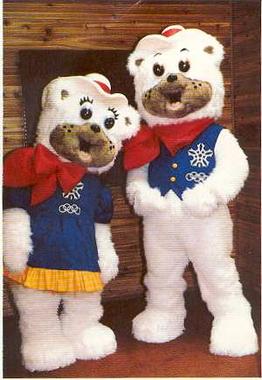
Hidy and Howdy, the mascots of the 1988 Calgary games

Logo from Wikipedia. 'The Games are also remembered for the "heroic failure" of British ski jumper Eddie "The Eagle" Edwards and the Winter Olympic debut of the Jamaica national bobsled team, both of which would be subjects of major feature films about their participation in the games.' Unlike the financially disastrous Montreal games in 1976, the Calgary games actually made a profit, largely because they had soaked ABC for $309 million for the American television rights. The games turned out to be a flop for the network, which was forced to remand payment to advertisers for the dismal ratings they generated.

Bush needed not just a win in Maine, but a huge win.

Fittingly, on the next to last day of February, on the day that the underwhelming 1988 Calgary Games stumbled to a close, the voters of Maine gave Bush the crushing 64% victory he needed. Dole was humiliated with 8%. Even Robertson beat him.

Dole had not even competed there. That was a fatal mistake for him. He should have pressed his advantage. Never concede anything. This mistake was all Bush needed to right the ship in the media. Suddenly Dole was the one seen as weak.

From L.A. Times.  Feb. 29, 1988.


Maine was the very soul of the Republican Party. It was special. The results were a huge resounding message from Down East, a rebuke to the states that had voted against their favorite son Bush, and a bugle blast to the ones yet to follow: we know Bush and this man must become President!


To Bush it must have felt as if the spirit of the commemorated Union soldiers in the statues had risen up to give him a smashing victory.

Moreover, the victory in Maine was not Reagan's playbook but all his, as unique as his moment in history. It would be his great turning point.

In 2016, Ted Cruz scored a strong and rather unexpected (46%-33%) victory over Trump in the Maine caucus on the weekend after Super Tuesday. It would be Cruz's sole victory east of Wisconsin. At the time it allowed Cruz to pour cold water on Trump's momentum coming out of his Super Tuesday triumphs, and to set the stage for a month of Cruz momentum. In a way Cruz borrowed a bit from Bush's script in 1988, using Maine as hammer to change the narrative of the nomination.
from Google

Late Feb. 1988: Bush at Nadir

Despite his victory, the New Hampshire primary was actually a disaster for Bush.  It simply confirmed the suspicions about his campaign.

He followed it up with a quick win in Nevada, barely edging out Dole 27%-22%. But then, as now, the Silver State was seen more in the realm of a wild-and-wooly caucus subject to crass manipulation.

Pat Robertson, who had made a specialty of these events already, popped back into the teens in Nevada for 15%. Jack Kemp was now climbing at 13%. He had apparently begun to solidify Pierre du Pont's voters behind him.

Nevada had been just another must-win for Bush, to keep the sheen of having some inside tack to being Reagan's successor. All he had proved so far as the voters weren't ready to throw him out of contention.

The momentum seemed clearly with Bob Dole, and now also with Kemp.

And then the bottom dropped out for Bush:


On Feb. 23, eight years to the day of his being humiliated by Ronald Reagan on live television at Nashua, Bush was kicked in the teeth by the voters of Minnesota, who sent him to a dismal fourth place at 11%, and also by South Dakota, where he finished in third. The two states confirmed Dole's early strength in Iowa, and extended it to a larger territory, where Bush was apparently weak.

Populous Minnesota gave Dole a solid dominating win at 43%, and even put Bush behind Robertson 28% and Jack Kemp 15%. He had done a little better in South Dakota, although had still lost to Robertson. The next day, Wyoming chimed in with a similar 3rd place result for him behind Dole and Robertson. The only good news was that Kemp was struggling with erratic support. There was still hope.

It must have seemed like the unthinkable was happening: Bush was losing.

The fight will be tough. No time to lose one's head, he must have said to himself. You are a Bush. You are made of strong fiber, the best of what makes America good. Time to rally and figure out the path forward. There has to be a path that leads to victory, even if it is narrow. 

But his comeback needed to happen fast.  If he lost momentum, and lost the election, America would go on without him. Moreover, and much worse for him and his family, the Establishment would go on without him. It would find new leadership, someone to lead it forward in history. That was how it had to be.

But without him being elected the world would not go forward in an Age of Establishment Glory.

Unconsciously or consciously America must have ached for him to win because he was, he knew, as close as one could get at that moment of history, to embodying the genius of the American system, and all the best strains of its history on the continent.

He had spent a lifetime becoming that, and getting to this position. He had served the best interests of America at each step of the way.

America needed this new era to happen, with him guiding it. What else could have been the purpose of his life, in doing all that he had done?

The world needed this new era to happen, lest the nations blow themselves apart in their ignorance.

He alone knew how to make it all happen

Bush had to win.

Friday, May 13, 2016

February 1988: Bush Against the Wall

continued from 1988: When Bush Became Bush.

"Dole Wins in Iowa, With Robertson Next" from the N.Y.Times
"...threatened to be a humiliation for Mr.Bush." (from the article).

They had known going in to the election that it was not a lock. One must expect crises. They must have had a plan for this scenario. Still the reality of it must have been heavy for them, with a sense of urgency to fix things as soon as possible before it got worse. The window of history was short.

In some ways, this was exactly the kind of situation Bush thrived in, to be thrown up against the wall. He took it as a personal affront, and would marshal all his will to rectify it.

Moreover, just as he had learned from Jimmy Carter's 1976 that the Iowa caucus was the secret route to the nomination, he had a playbook to follow. Once again, it was supplied to him by the very man who had beaten him, namely Ronald Reagan.

In 1980,  by skillful and subtle ground game like Carter in 1976, the quiet Bush had pulled the same upset win over Reagan in Iowa. It had been seen as possibly putting Reagan's drive to the nomination in doubt.  Reagan, after all, was a Midwesterner. He had been a popular radio announcer in his youth in Des Moines. His loss there had the air of a mild rebuke.

What followed after Iowa that year a long four weeks until the New Hampshire primary. There was enough time for Bush to pad his momentum with a guerilla-style victory in the largely uncontested Puerto Rico, which the Republicans had hopes of admitting as state in the near future, (based on the idea that it would almost automatically supply two Republican members of the U.S. Senate)*. A headline is a headline. A victory is a victory.

Things had started looking for good for the upstart, obscure "Ambassador Bush."

But late February, just one day after the "Miracle on Ice" at Lake Placid, at the television debate in Nashua, N.H., the California governor had elevated himself to cult figure status with his famous angry confrontation with the debate officials on stage:


From Youtube. February 23, 1980. When Reagan became Reagan. His glare across the stage, followed up his  claim to be "paying for that microphone", was greeted with wild enthusiasm by the crowd, who saw in him a figure who could take on and defeat the Establishment. It was especially humiliating for Bush, in that other candidates, including Bob Dole, Howard Baker, and John Anderson actually joined in the applause for Reagan. Bush in glasses can be seen looking at the other candidates, in confusion as to what he is supposed to do. It was as if the contest had been settled right then and there with a unanimous endorsement by acclamation.
Four days later, Reagan won a crushing 50% victory in New Hampshire, and in many respects, he never looked back:

1980 Republican primary results

1980 Republican primary results as of February 26.

For Bush in 1988, following Reagan's post-Iowa recovery script seemed simple, but there was already a problem. Bush could get his dander up like anyone. That was not the issue. Rather it was the simple fact that unlike what Reagan had faced there in 1980, New Hampshire in 1988 was widely seen as home court for Bush.  Officially he was a Texan, and he held residence in Houston, but in the public eye he was still seen as a Preppie New Englander who made his home as much in Kennebunkport, Maine.

So his victory in New Hampshire the follow-up week could not automatically carry the weight that Reagan's victory there had, as solidifying him as the front runner. New Hampshire was seen as a must-win for him.  Only an overwhelming victory, as he had in the Michigan straw poll, would serve to put the sheen of the winner back on him.

The results on Feb 16 were not very encouraging for him:

1988 Republican primary results

As of Feb. 16, including the straw polls leading up to the Iowa caucus. from Wikipedia
Bush had won, but with only 38% of the vote.  Dole was not squashed down in the teens but was fairly close behind at a solid 29%, making him apparently the most national candidate in terms of his crossover support. Moreover, Jack Kemp and Pierre du Pont were showing enough support to hang around and to cut deeply into Bush's base, right as Dole was picking up a little steam.

The only good news was that Robertson only got 9%, marking him as a regional candidate. Yet that had been the general assumption all along, that Robertson was no real threat, so it was only mild comfort, given the other issues he was facing.

Dole's second place finish was almost a win. Suddenly it seemed as if America was ready to embrace a Bush-less future.

*Gerald Ford had advocated Puerto Rico statehood as a lame-duck in Dec. 1976, after being defeated by Carter. He announced his support on camera while skiing in Vail, Colorado.