Friday, January 10, 2025

The Book is Back!


Color plate from a real edition of H.E. Marhsall's Stories of Robin Hood, showing Richard revealing himself as king to Robin and his men.

Yesterday I made sure to go out to the park, to maintain my habit of walking. When I came up towards the little free library kiosk, I was rueing the loss of my book before I could finish it, but as I walked towards it, I thought to myself, "well, maybe it will be back."

It seemed like a longshot, but nevertheless I would look. So I opened the door and I didn't see the book. But then I began rummaging through the books, just to double check, and lo and behold, there was the copy of Stories of Robin Hood Told to Children sitting between two larger children's books on the bottom shelf.  I pulled it out with joy. It the same copy, to be sure, with its creased cover and yellow highlights. Now it felt like a treasure. I was filled with a wave to joy to be able to continue.

I immediately walked it over to the picnic table where I sat with it, reading the next chapter, which was Chapter 8 about the return of King Richard.

Richard has now heard much of Robin Hood and wants to meet this interesting fellow. He travels to Nottingham and goes into the Green Wood with his men hoping to meet Robin. But Robin always sees him coming and hides from him, as he respects the king and does not want to harm him or menace him in any way.

The frustrates the king, who does not want to harm Robin, or to meet him.  The Sheriff of Nottingham advises him that in the king and men were to dress as monks, then surely Robin would intercept them. So the king does that, and now we have the king and his men all in disguises.  Yet another twist on the disguise theme.

The ruse works. Robin and his men intercept them, but upon discovering the monks are loyal to the king, Robin affirms his loyalty as well and says he would gladly serve the king if he could. At that point the king removes his disguise and reveals himself as Richard.  Robin and his men kneel and swear him allegiance, and to serve him. Then they have dinner together and the king sees the wonderful forest society that is flourishing under Robin. Then everyone marches out of the Green Wood together. Robin and his men go to London. 

The story says that unfortunately Richard later dies, and his tyrannical brother assumes the throne for real, and that Robin and men are forced back into the Green Wood as outlaws. Nevertheless for a brief moment, there was justice in England.

When I finished reading the chapter, I closed the book and looked at the copy I was holding. Could I possibly have missed it yesterday. I had thought I had meticulously looked through all the books, twice in fact. But who knows? Or was it returned? I'll never know.

I felt such happiness to have it back. I decided at once that the original intention I had made for my secret book club, to leave the book in the kiosk each night, was no longer binding. The book had been set free but it had come back. I decided that I would take the copy home with me, at least for one night until I was finished with it, and now the little yellow highlighted book is by my side in my room. Maybe it will stay with me, and be part of my library permanently. Tomorrow I go out and read the final chapter.


Holding on by our Fingernails

Sadness around the household today. After waking up, Jessica told me Fred's son has passed away during the night. He had been diagnosed with metastatic cancer last year. They were in the process of moving him into hospice.

Jessica asked me if I would call Fred this afternoon, and I said gladly. I had been praying in my room for his son's soul, saying the Rosary several times. Fred is going to fly up to Cincinnati later today.

I love Fred tremendously. He was one of the few people I can talk to. He worked for many years as a Ford engineer in Ohio before retiring. He is a congenial man and gruff in his conservative look on life. He married Jessica's mother some time in the 1980s. He and Jessica's mother live down in Mesa at an RV park, where they own a permanent pre-fab home. We have breakfast with them pretty much every Sunday morning up here in Scottsdale. 

I generally get along with men of his generation more than my own. There is something that happened to Americans right around the time I was born in the mid 1960s. We can't make friends and connect to people in a genuine way like older generations could do. I've known this my entire life. At one time I realized that the parents of my high school friends were much dependable as "friends" than the people my age, for whom friendship is something that comes and goes, and can be discarded. It was one of the things that made me realize early in my life, from childhood, that the world was a broken and lonely place, and for much of my life it has felt like that. I don't get how people just let friendships die, but they do, as if you can just order new friends online and have them delivered. Human relationship are commodified.

I guess I'm a little off topic, but since I didn't know Fred's son, I can't speak about him. I know he led a troubled life and had a difficult time taking care of himself, going through one addiction rehab program after another, and living in squalor. 

Some days I cannot bear feeling the pain of people out in the world---all the pain and suffering, and the isolation and abandonment. Some days I can look out the window and almost see it out there, the desperation of lost souls, and in between them, the people who seem to be able to not care about it all, and how weird that seems. Some days every human contact feels like a gift of mercy. Some days it feels like we are all just holding on by our fingernails. 

Thursday, January 9, 2025

The Lost Kingdom of the Undeveloped Desert

By the end of yesterday, I had gotten over the loss of "my" book, and the attendant routine I had come to enjoy since New Year's Day, of walking out to the park and reading a chapter while sitting at the picnic table in the shelter. Of course, I could have taken the book for my own and then walked out with it to the park, but somehow it didn't feel like the right thing to do. In that sense, it was a test of my character, to cope with losing it. It felt like it was meant to happen.

It had all begun only last week as a way of getting me to take more walks outside in the New Year, after a year and half of feeling cooped up. Perhaps that is what I missed immediately, the motivation to follow this new routine, and also the feeling of it being the New Year. I love New Year's Day. It may be my favorite holiday. I love that it is an arbitrary date on the calendar, but everyone gives themselves permission to feel like the world is, fleetingly, brand new again. I love the low-number single-digit days of January and always feel a little sad to see the world settle into the everyday calendar again. Seeing the book missing yesterday was like being rudely jolted out of my extended New Year's dream, like an alarm clock going off rudely while one is in the midst of a pleasant dream (note I almost never use alarm clocks, and when I do I invariably wake up before it goes off.).

The other subtext in this drama is that last year, going for walks in the little park had become painful. This is because, as I mentioned, they finally got around to clearing out the rest of the undeveloped desert that I have cherished so much since we moved here. The building of the park itself had been the first step in that, back in 2021, but it left the vast majority of the remaining land untouched for the time being, and it remained my almost private wandering area where I could get "lost". I done this kind of things since I was boy, making a piece of woods or a vacant field into my little of kingdom. 

I know it makes me "weird" and few understand this about me, that I can turn a bit of scrub desert into my own palace grounds and give names and character to each part of it, like Adam naming the features of the newly created Earth. So rare is it to find someone who understands this too. There have been so few people in life who understand how I am constantly driven into some form of "magical thinking", where I am compelled to interpret my life in some kind of mythopoetic storyline, even on the smallest everyday level. If I take you into my confidence as a friend, then I begin to share these things with you, and share the sources of magic around me, if I sense you think me mad, that it is ok until you call me mad, but then we must part and I must go on my way. There is no sadder moment than when a shared magical journey stops, and one is left alone, the mourn with the confort of the trees and the landscape that once was the text of a fairy tale before one's eyes.

This kingdom of the undeveloped desert was not my property. .Except for a small rump section, has been scraped to a flat brown plain, and what remains will taken soon as well.  It's like a nuclear exposion to destroy the magic terrain. I could turn away from the sight of it and mourn the loss of my kingdom in private, but as I walk up the path of the park around the pond, I am confronted by the vision of this featureless plain stretching all the way down a half mile to the highway. Soon they will begin paving it over no doubt. My mind wants to see where the dirt road once went under the power lines, where I could pace out my thoughts and draw together ideas into a creative whole. All of that is behind. work fence now. The little draw that wound down towards the highway, flanked by delightful brush where animals played, is totally gone, replaced by a chain link fence that feels like a prison.

All of that was too much to bear last fall as it was happening, which is why I stopped going to the park. It was too painful. Somehow the library and my book club allowed me to pretend all of that wasn't happening. I often go walking without my contact lenses or glasses, and so it was easier just to cope with things that way, and not see the blankness of terrain, awaiting the asphalt, that was once such a joyful bit of discovery each day. I could focus entirely on the little library.

Thankfully, amidst it all, there still remains the little bit of paradise that was my original private sanctuary---the Sandy Bottom, as I have called. That part of the draw still remains because it is just inside of the original dedicated park, but was never developed. The draw will never be filled with water again, due to the re-engineering of the drainage in the park, but the Ironwood lives on, as does the Saguaro and the Palo Verde nearby, although I rarely go and sit there as I did, because there is no longer the same privacy in doing so. One feels rather "on display" there to people in the park walk on the road that passes nearby, that did not exist before. 

And thankfully the "Chapel" is still there---a spot along the old draw just downstream from the Ironwood but upstream from the draw where several trees hang over the channel of the draw to create an interior space that is private but from which one can see out. The Chapel barely survived. Alas just downstream from it, the channel is now cutoff by the chain link fence and where the full scraping of the land begins. The delighful row of trees there have been uprooted and removed. 

The pain in my heart remains for the other places in my kingdom that I cherished that are now permanently gone, a victim of zoning plans made decades ago now being undertaken, despite the change of character of this part of Scottsdale. 

It by no means the first time in my life that I have carved out a private kingdom for myself like this, that only I seem to know about but which is ignored by everyone else. Over and over I have seen such places taken away. That's the way of the world. I will get over this as well. The destruction of it will make it easier to leave this place when we go, whenever that is, hopefully to a place where I can wander along forest paths again. I miss that a lot. Perhaps it is a blessing to be able to detach from it in that way.

Today, however, while we still live here, even though we are leaving behind the magic single-digit days of the year, I intend to go walking again into the park, and I will bring my own book to read, and it perhaps become my own book club again. I think I already have the book in mind.

As for the.yellow-highlighted copy of Robin Hood, my mythopoetic impulse drives me t to interpret the fact that yesterday I found the door of the little library flung open when I arrived to mean that the book, like a bird, escaped from its cage and was set free. A copy will come back to me when I am ready to finish it.  Patience. King Richard shall return yet.


Wednesday, January 8, 2025

Book Club is Canceled

 The day's walk to the park found me in my usual high spirits. It had become part of my routine that lifted me up. I passed the pond, which was sparkling like shower of gold was laid over it. Then as I approached the little free library box I got a sinking feeling. The door was flung open and something didn't feel right. My dread I looked inside. It seemed like the same books were on the shelves, but when I looked for the familiar copy of Stories of Robin Hood, I found it was no longer there.

I had told myself I would be happy if someone else took it, for it meant sharing it with someone, but when it finally happened, it greatly saddened me. Such is life. I was just up to the 8th of the 10 chapters. "Why couldn't it have waited a couple days?" Hopefully whoever has taken it is enjoying it as much as I did.

Of course I could get another copy and finish the story, Perhaps I will do that, but some part of the magic of it all feels interrupted. 

Disguises, Disguises, Disguises.


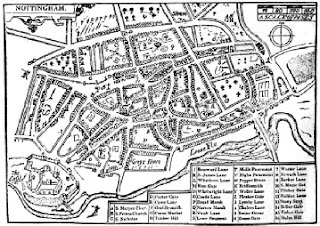
Map of Medieval Nottingham, the site of the Silver Arrow contest.

Disguises. Disguises. Disguises
. The usage of disguises grows as the Robin Hood story goes on. In Chapter 7, "The Silver Arrow", we see the hero go from the bliss of finding his long-lost friend of his heart and taking her as his forest bride, to facing peril of death with all of his men. This time it is directly under the gaze of the Sheriff of Nottingham, and Robin brings it about deliberately.

Where the story picks up in this chapter, King Richard has returned to England from the Crusades explicitly to put aside the tyrannical rein of his brother Prince John. Meanwhile the Sheriff of Nottingham has grown apoplectic over his failure to capture Robin. He (painfully) spends a great deal of money to travel to London under heavy armed escort to plead with the king for more resources to capture the rascal, who has been abusing the king's own forests. Unimpressed, the king dismisses him and sends him home. The Sheriff is humiliated and very angry.

He devises a plan to lure Robin into his clutches---an open archery contest in Nottingham. Being a man obsessed with wealth, he thinks in terms of silver and gold. The prize of the contest is a silver arrow with a gold tip as a prize. Robin will surely want to win the prize. He is sure this will work. 

On this, he is correct. The plan might well have worked but for the fact that one of Robin's men, David of Doncaster, has a sister who works as a maid in the household of the Sheriff. David visits his sister clandestinely and she tells him of the plan, in order to warn Robin that the contest is a trap. When David returns to the forest, he finds Robin has already heard of the contest and is planing to go. At first he brushes aside the warning from his own man, mocking his caution and cowardice. Then he hears about the details, and the thoroughness of the Sheriff's plan. So he adjusts his own plan. All of his men will go, each one in separate disguises.  

They make their way into town and blend in, in groups of two or three, and the Sheriff never suspects them. All the while he is looking for a group of men in Lincoln green, but none ever materialize.

Of course Robin wins the contest and is presented the arrow by the wife of the Sheriff. Afterwards she tells the Sheriff how much the contest winner resembled the charming butcher who once came to dinner. To seal the victory, Robin later delivers a letter to the Sheriff by means of an arrow that he shoots into the castle. The Sheriff now realizes his own idiocy and rages, vowing revenge. 

Marian does not make an appearance in this chapter. In the version presented in the 1938 Warner Brothers movie (which is itself based on other narrative-space variations of the story), it is Marian who takes the role of presenting the arrow to the winner.  The contest in the movie is being held by Prince John who has not yet been deposed (Claude Rains makes a superb villain in the movie). 

Sitting next to Marian, and knowing she is in love with Robin, the Prince watches her like a hawk for her reactions to the various contestants, and by this he discerns Robin's disguised identity even before he wins the contest. He savors the moment of letting Robin advance to the podium where he can spring the trap right in front of Marian.

According to classical Hollywood poetics, it is to Marian's virtue that she cannot hide her love for Robin. A woman in love can never truly hide it, and when pressed, she cannot deny it (but only a cad or a villain would press her on such an issue). Had she been able to conceal her feelings completely, she would not be worthy of being the true love of such a noble soul as Robin. Even if she must verbally deny her love for him, for example to save his life, her face and her voice cannot conceal her true feelings. This is, in fact, the glory of woman that she cannot hide her true love. A man who loves her may know this about her, and he conveys to her I can see right through you, and I like what I see.

A sociopathic villain, however, will also see right through her, in a coldblooded way, as does Prince John in the film (but not the Sheriff in the book, as this is much easier to convey with the camera than in print). Thankfully, in story terms at least, her virtue will save her. As a woman, she is vulnerable and in need of masculine protection, but also her love ultimately makes her invulnerable to the villain, even as he thinks he can read her like a book and anticipate her every move. He cannot see in her the depth of feminine power that comes from true love (otherwise he wouldn't be the villain). He cannot account for the power of the Spirit of Love to act in a spontaneous chaotic way that will foil his plans. It is the feminine submission of the heroine that invokes this Spirit to act to protect her. I love the way classic movies invariably brought out this theme.

In the book version, the Sheriff literally has everything he wants right in front of him, but is blinded by greed and hate. Ironically the Sheriff himself has a splendid wife who had effectively saved his life in the first encounter with Robin, and then, after the arrow contest, unknowingly provides the the service of telling the Sheriff he was duped.  Is it implied subtly that the Sheriff's wife saved his life a second time? 

Consider Robin's arrow message to him at his residence is seemingly superfluous in story terms. Why have it? The Sheriff already knows, because his wife told him. Of course, Robin himself doesn't know the Sheriff knows, but we do. Robin could have found out by other means that the Sheriff figured it out. Why have the whole episode of Robin going in to shoot the arrow? For closure purposes with a second arrow shot? Maybe.

If nothing else, the wife's informing him after the context told him how easily Robin was able to penetrate a high-security setting and to approach the Sheriff in person so brazenly. The Sheriff henceforth would be more on guard, fearing the next appearance of Robin. Robin does in fact go to the Sheriff's house, to shoot the arrow message. It serves Robin's ego to do this. He's rubbing it in, and only asking for trouble. 

By putting the Sheriff on guard as she did, the wife perhaps prevented Robin from ambushing the Sheriff and doing harm to him, perhaps killing him. This would have been bad for all involved in the story. Among other things, it would have prevented King Richard from coming to Nottinghamshire (as he is about to do) and fairly judge the conflict between the Sheriff and Robin. The King would been forced into an antagonistic position against Robin from the beginning. What a disaster.  Justice would not be restored to he kingdom.

I admit I sort of made all this last part up by speculation. I see no indication in the story that what I described in overtly implied. Rather I would argue it is a possible interpretive variation of the story. The continued vitality of the Robin Hood narrative in Anglo-American culture, however, means it is still possible to generate variations in the narrative space such as this, in a way that appeals to the curiosity of audiences. Sadly Hollywood has mostly forgotten how to do this, and instead it relies on cheap surface variations like changing a character from straight to gay, or white to black. It would all be so funny if it weren't depriving entire generations of the power of story to inform people of how to construct somewhat happy lives and avoid ones that are shitty and soul-killing. 

When shall Love flourish again, without disguise or guile? When at least shall the King return and restore Justice to the benighted land? 


Tuesday, January 7, 2025

An Anti-Feminist Reading of Lady Marian Fitzwalter

In the 1938 Warner Brothers film, Marian is played by the late Olivia de Havilland (1916--2020). She was one of the last living links to an entire era of movie history. I have seen this film at least a dozen times on TCM. It was one of Robert Osbourne's favorites. Like him, I absolutely love this movie and easily place it in my all time top ten. Among other things, it could be Exhibit A in a contemporary college film course on how movies inform our knowledge of male-female roles, and we learn to conform to such roles, and come together as men and women, through this viewership in a postmodern way. In fact I took exactly such a course in Salem, Oregon in 1988 but we didn't see this movie. I only saw it years later.  In this version Marian and Robin have a different origin story than they do in the book I am reading. They don't meet until Robin is well established in the forest as an outlaw. Marian is aware of Robin's outlaw reputation before she meets him and predisposed to like him, as she is aware that England has fallen into tyranny, but as a woman, she remains unaware of the deeper implications of this until her eyes are opened by a man. The director Michael Curtiz (who also directed Casablanca) lets us see Marian fall in love with Robin when he meets him. The screenplay calls for her to be less overtly masculine than the 1912 children's book where she wears a suit of armor in the woods. As per the usual classical Hollywood poetics, her power remains overtly feminine in nature as a character, and we see her in scenes that reflect her domesticity. She stays as the "fixed point" in the castle, attempting to manipulate events on behalf of Robin, who is the active masculine out in the world.  Robin (active, masculine) can communicate with her, but she (passive, feminine) cannot communicate back to him (when she is finally forced to do so, she almost gets herself killed). She never betrays him, even to the point of bringing upon herself a death sentence for treason. They are the perfect masculine-feminine balance in the perfect love story. De Havilland's performance here was no doubt a huge reason she was cast the following year as the iconic Melanie in M-G-M's Gone With the Wind

Let us revisit the Green Wood. 

Imagine a scene deep in the forest, along path two strangers approach each other--two knights in armor one large and one smaller and thinner. They dismount and engage in mortal combat, hacking at each with swords for an hour, with the bigger one getting the best of the smaller one. The smaller one suffers a severe injury and appears on the edge of defeat, maybe death.

This is the story in chapter 6--except the knights we see are not actually knights. The armor of both of them is a disguise. Moreover, one of them, the smaller one, is revealed, to the astonishment of the larger knight, to be a woman.

Moreover, it so happens that the two parties know each other. They have known each other for a long time, since before the start of the events of the book. Moreover, they were deeply in love with each other, and planned to marry. But due the circumstances of the world, they were parted and have not laid eyes on each other in a long time.

Yet when they are revealed to each other, they fall upon each with kisses, as if day not passed. So deep is their friendship, much do they love each other, and so happy they are to see each other again, and hold each other in their arms. 

Of course the man is Robin Hood and the woman is Maid Marian, the daughter of the Earl of Fitzwalter, who lived nearby to Robin's father's castle, before it was burned and Robin was forced into the exile of the wood.  Because Robin truly loved here, he had to cut off contact with her and go on without her. But it is clear he never stopped loving her. Who could replace Marian?

Yet he almost loses her again, after the happy reunion in the Green Wood. She wants to stay with him.  When a woman loves a man, she wants to be with him always. Robin tells her it is too dangerous, and the forest is no place for her. This is despite that she put up a good hour's fight against him while wearing armor.  We know Robin is underestimating her hardiness, but that is what a gentleman is supposed to do. He is supposed to tell her to go home, and she will have none of it. A woman who is truly in love will tolerate the most extraordinary circumstances of living to remain with her beloved. Just never leave me behind.

All of this important because it proves Marian is worthy of being Robin's bride. He is an extraordinary person himself and much justice depends on him, as well as the lives of many others. We need him to be with a woman who can match his masculine energy with a feminine form of it. 

Modern audiences and criticism would make much about the gender-bending of having her fight as a knight. A modern "girl power" Hollywood movie would require her to get the best of him, to prove girls are better than boys.  Nobody wants to see that except disturbed people who hate real women.  Everyone is else is just pretending to like that because it makes the right statement "for the benefit others." The Medieval version is the correct one, pushing the masculine energy of Marian as far it could possibly go,in actual combat. Ultimately she surrenders, and because she is pure, in surrendering she get everything she ever could want, and will live happily ever after.

Of course they did the correct thing for the day and got formally married by Friar Tuck by nightfall.  But no! says the modern audience. This is too rash! Don't they need some time to think it over?

The truth is they could have been married much earlier, had Robin believed that Marian was up to being the bride of a forest outlaw (which she always was). 

Nevertheless, at this point in the story, the good masculine and good feminine are in harmony and operating in their high registers. We know nothing truly bad can happen to them in the rest of the story. They will face trials, no doubt, even ones that threaten their lives, but we know they will triumph over them and remain together. We already know they will live happily ever after. 

So now we understand why Robin sent the old woman to Marian, when they were still in exile. 

Imagine that forest scene, when Robin takes the visor over his vanquished competitor and sees his beloved looking back at him. Imagine how the world must have sang for him some incredible hymn. A man truly in love with woman does not worship her like a goddess. Such a thing is repulsive to a woman. Instead he sees in her, and through her, all the things she cannot see about herself. The missing part of him has been found, re-found, and given back to him. That's what good stories do, either in children's books or in Hollywood movies. Ah, youth!


Ironically in the children's story we see the situations faced by modern would-be lovers trying to find each other. Having to put on armor, and disguise ourselves as ferocious and scary warriors to each other. Is there a better metaphor for the way mean and women try to find each other today? So few people ever get the opportunity to look into another's eyes and recognize their beloved. Such a thing requires, for both sexes, a vulnerability that is either (for women) considered to be a manifestation of oppression, or (for men) cultivated in an effeminate register out of an inability to connect to a true masculine ability to lead the woman. Everyone loses out.  


Monday, January 6, 2025

A Structuralist Take on Robin Hood


I went online and found this older edition of the book I've been reading on my walks out to the park. I have not purchased it but I might when I finish the version I h ave. The author H.E. Marshall is actually "Henrietta" (I had been picturing the classic movie actor Herbert Marshall!). The original edition was published in 1912. The one above is no doubt a later edition. The version I'm reading in the park is a cheap paperback reprint with black and white reproductions of the color plates from the original, no doubt published as such because the book is out of copyright at this point.  All of this has gotten me interested in the actual history of the Robin Hood legend--what are the "original" sources and how they evolve over the centuries. 

Robin Hood is about defying corrupt authority, both secular and religious. His deceit of the greedy Sheriff of Nottingham in Chapter 4 is followed in the next chapter, Chapter 5 "Robin Hood and the Bishop, by a similar but anti-parallel encounter with the malevolent Bishop of Hereford. 

The Bishop of Hereford has a hatred for Robin because of the humiliation he suffered at Christabel's wedding. He also knows he can collect a reward from the Sheriff if he captures Robin. He is as corrupt as Church authority can get. 

I saw anti-parallel here because it follow the rule I noticed in Hollywood movies---nothing is ever repeated exactly. There must always be at least one prominent variation of a story element. There is always a switch of polarity on some axis within the narrative. For example, the Sheriff follows Robin foolishly into the forest alone, without guards believing himself safe when he was not.  He has the Sheriff in his control the entire time and is never in danger.

In a structuralist sense, these elements switch polarities in the next chapter, which has the Bishop entering the forest on is own initiative, and accompanied by heavy guard of soldiers. He is under no delusions about his situation. He is seeking Robin explicitly, attempting to draw Robin out to capture him. With him he carries a large sum of gold which does not belong to him but to a monastery to which he is headed. It is pointed out that the monasteries at that time were corrupt as well.

In fact, the Bishop's men do spot Robin, who is alone and vulnerable, and barely escapes their hot pursuit, all the while knowing he will be executed if caught. 

Instead of calling his bowmen to come to him, he has to seek refuge out, in the cottage of an old hermit woman, for whom he has provided goods to her. 

With the Sheriff, he went into town in disguise. Here is flees from his pursuers and dons a disguise in order to escape. He does this by asking the old woman for a dress and cap, so he can pretend to be her, in order to evade the Bishop's men. Meanwhile she will wear his Lincoln green suit and cap and pretend to be Robin when the soldier's arrive. Robin promises to come to her rescue with his men.

Pretty much everything goes according to his new plan, and he intercepts the Sheriff and disarms his soldiers. Of course he confiscates the Bishop's gold, but instead of the stated reason being a meal that the Sheriff will get to experience later that day, it is as payment for the services Robin has already rendered

This is the way stories generally were constructed---by variations. I went through a Yale course on literary theory a few years back that turned me onto this.. Claude Levi-Strauss and Roland Barthes wrote much about this kind of thing in exploring what is known as structuralism

In a simple variation story, we might have only one alteration on the narrative axis each time leads someone into the Green Wood. For example a soldier of the Sheriff, then a captain, then the Sheriff himself. Instead we get an almost complete variation of the narrative between Sheriff and Bishop on many different axes of the narrative, as mentioned above. That means that in two passes, we have essentially filled out the entire "space" of narrative variation in a Levi-Strauss sense. There is hardly any room for a third such incident with further variation of the story. That tells me that the third time it happens---for there must be a third time---will be radically different than the first two. It must be in a whole new "story space". I can hardly wait.

Also in this chapter we finally hear of Maid Marian, who will finally make an appearance in the next chapter. In the meantime Robin sends the old woman of the forest off to Marian in order to be fitted with finer dress, and be placed in her protection. One thus knows of Marian's goodness before we meet her. We know she is a very important person for Robin.

Claude Levi-Strauss (1908-2009), the godfather of structuralism, which dominated literary criticism in the mid 1960s until the rise of deconstruction.  At first it was hard to grasp what he meant by the narrative space of a story, until I listened this lecture from 1984 in which he talks about the myths and legends of various isolated tribes in British Columbia as recorded by an anthropologist in the early 20th century. Every possible variation of the myth comes into being over time, as varies within certain constraints. He first noticed this about Oedipus and concluded that in regard to myths and legends, there is never a definitive version. All of the versions and variations contribute to a "story space" that builds over time. I think about this a lot in regard to the contemporary switching theace, sex, sexuality, etc. of well-known story characters, say in Disney or Star Wars or in comics.  Doing so is almost a trope at this point. It think it is well explained by the ideas of Levi-Strauss in regard to the need for the culture to fill out the expanded "DEI" story space of existing narratives. I've never heard anyone else say this, probably because no one cares about structuralism anyone, and my thesis here would probably be seen as reactionary/racist/homophobic/transphobic/misogynist but the numb-brained academics who know only "critical race theory." That is basically the only tool in their toolbox.  Even my late grandfather, who was a Marxist academic and professor of French literature, could not stand them. How far we have fallen since the 1960s.

Sunday, January 5, 2025

Beefmaxxing in 2025


A few days ago I read a post on X, the source of which I did not record, saying that 50% of the beef in the U.S. is consumed by a mere 12% of the population.  

"If that's true," I told Jessica, "then we are certainly in the 12%." 

She agreed, and I added, "we're beefmaxxing." 

She got the meaning of the term but did not know that -maxxing of various kinds is a meme phrase on social media, one that means maximizing one's effort in a particular. My research told me it began on the internet forums of pick-up artists in regarding to "maxxing" one's appearance and appeal to the opposite sex. Probably the term "looksmaxxing" is used more by female TicTocers than by men, and often focuses on make up. 

(source)

As far as beef, this is one of Jessica's big causes as a naturopathic doctor. In Portland, she spent no small amount of her time telling Vegan clients at the women's clinic on East Morrison to "eat some f@cking meat." Of course they would rather die than do that, which proves veganism is a cult of body denial. 

Also of course the powers that be want to ban cows and have us eat insects.  This is because the powers that be are sociopaths who want to kill us all, and they need to be fought with all our being. Being an enemy of cows as they are, they are easy to spot in their evilness. Cows are an amazing animal. They actually don't mind that we eat them. Trust me. Cows love people back. Some people think they shouldn't love us, but they do. God is able to do things like that, and the world is full of cows because they are our food. We should keep it that way.

Along those lines, today's reading from the yellow-highlighted and creased-cover copy of Stories of Robin Hood Told to Children, retrieved once again from the little red British phone-booth style free library (only the best for us here in Scottsdale), found me at Chapter IV, entitled "Robin Hood and the Butcher." In this chapter we meet the nasty tyrannical villain, the Sheriff of Nottingham.  

Robin is out walking in the Green Wood and spies ahead of him a butcher riding through the forest. The butcher's paniers are laden with beef from his heard. He is on the way to market in Nottingham to sell it. 

Robin, formulating an idea, offers to buy not only all the butcher's meat, but also his clothes and his horse with the paniers as well.  The butcher agrees and goes merrily on his way. Robin then dresses us as the butcher and rides into Nottingham, somehow bemused and confused by the market. He begins selling his meat, but the price he offers is severely under the market value, attracting not only the crowd of buyers, but also the other beef sellers, who wonder who this foolish rogue is, selling at such a low price. This attention attracts the Sheriff, who seeing the meat is high quality, and this new butcher is a fool when it comes to knowing its value, invites Robin to dinner (which he has each week with all the butchers) with the intention of buying his cattle at an absurdly low price. The Sheriff begins counting his money in his head even as he rides away.

Robin goes to the dinner at the castle where he is warmly treated by the Sheriff's wife. The dinner goes well and Robin's merriment has even the other butchers relaxed and enjoying themselves. The Sheriff insists on accompanying Robin back to his pastures. From his storehouse he withdraws sacks of gold, which he knows is far below what the cattle will be worth.  He sleeps with the sacks that night. This implies no intimacy with his wife. Here again we see Robin as an agent of Love.

The next day the Sheriff, without his normal escort, follows Robin into the Green Wood, growing increasingly nervous. Robin blows his horn and his men, including Little John, show up and surround the Sheriff, inviting him to dine with them, but warning the price will steep, as it is for all of the wealthy guests who wander into the Green Wood. 

The Sheriff is relieved of his money but is not harmed. Robin tells him that he would hang him, but for the fact that his wife was kind to him.

It is emphasized in the story what an evil man the Sheriff is, terrorizing the Saxon population and having no care in severing limbs and fingers. This idea of authorities who participate in terrorizing a local existing population on behalf of conquerors is something that is raging in the news today about England. In some ways we have way worse evil going on in the North of England than was happening in Robin Hood's day.  


Saturday, January 4, 2025

Down the Rabbit Hole With Allan a Dale and Christabel


From wikipedia: 1912 depiction of Alan-A-Dale by Louis Rhead

Yesterday, the third day of the new year, I went out to the park around the same time of the afternoon, but the sky in the west was overcast with a clumping of stratocumulus and cirrus over the distant mountains, dimming the sun and giving a darkening late afternoon light that would still provide plenty of light for reading.

As I approached the free library box, I began to hope that my Robin Hood book would still be there, as I had gotten used to my little solo book club. When I opened the little door with its big wooden handle, at first I thought the book was gone, but it turned out that the books on the top shelf had been rearranged. Later I reflected how it was good that the book had yellow highlighting and some water damage, as that would make it less likely that someone would snag the book based on aesthetic appeal for their alone. 

Immediately I marched the book over to the picnic shelter and read the next chapter, which the day before I had seen was about the wedding of Allan-o-Dale. Allan-o-Dale is not a character I knew much about, other than the was played by a rooster in the Disney cartoon, which I last saw, if ever, in the late 1960s.  Looking the name up in Wikipedia later, I saw that he was probably a later addition to the Robin Hood canon, although he is attested in old English ballads.  In the 1938 movie The Adventures of Robin Hood (the most significant classic Robin Hood film), he is not in the story, but is combined with the character Will Scarlet. 

In my book-club book, the story of Allan-o-Dale is borrowed from old ballads. It goes like this: one day Robin Hood is out in the Green Wood and sees a young knight dressed all in scarlet red, singing and in merry mood. He tells his merry men about the knight and the next day they accost him. Only now is dressed all in grey and in a deeply sad mood. Upon questioning he reveals that he had intended to be married to his true love the day before, after waiting seven years for year, but that he had been told by her father that he could not have her, and that she was instead to be married an ugly old knight the next day.

Robin finds out the location of the church in which she is to be married and infiltrates it as harper. He discovers that the women of the community feel pity for the bride. He confirms that the bride loves Allan-o-Dale and is approaching her wedding day as if it were going to be funeral.

Being Robin Hood, he decides to act in favor of the life force, and restore true love to the young lovers. He has arranged for four-and-twenty archers of his band, as well as Allan-o-Dale and Friar Tuck to be present when he interrupts the wedding and insists that the bride pick her husband from among the men present. Her cheeks flush with life when she sees her true love, Allan-o-Dale. 

There is an interesting twist in that the Bishop, whom Robin distrusts, as he disobeyed Richard's orders by giving rulership over to Prince John, states that the wedding between the young woman and the old knight was already announced three times in church, which is the minimum requirement for a legal wedding. Robin improvises by saying that he will go around the church asking for objections person by person seven times, which he does, and receives no objections. But this is because his men silence both the father of the young woman and bishop. Friar Tuck performs the ceremony. In some variations, Robin himself performs a "forest wedding." 

This is amazingly both anti-patriarchal and partriarchal. In the name of true Christian love, the living spirit of the land, acting as a regent of God, restores the natural order (true love) because both the religious and secular hierarchies have fallen into deep corruption and disorder.  The classic 1938 Warner Brothers movie has Robin tell the returning King Richard to his face that his absence was the reason his kingdom fell into tyranny, requiring an outlaw to act as an agent of Justice (and Love, in a very Celtic Green Man sort of way). 

Ah youthful love! What do the young know but folly? A forest marriage, with an outlaw? What kind of life is that? Last night I woke in the night wondering if the young woman would have been better off obeying her father and following the dictates of ecclesiastical law. 

In the H.E. Marshall version I am reading on my walks for this book club, the true love of Allan-o-Dale is called Lady Christabel. The name was familiar to me from a book written by an Englishwoman named A.S. Byatt I had many years ago about two fictional Victorian poets, one of which was named Christabel. I remembered I quite enjoyed the book, which had an intriguing dual plot with one set in Victorian times between the poets and another in the present day (1990) between a man and woman researching these poets.  So I went down the rabbit hole, as they say, on the name Christabel to see if there were any direct connections with the rescued bride of the Robin Hood stories. I couldn't find any evidence of it, and it turns out her name is different in different versions of the story, and in some vesions she is the daughter of the Sheriff of Nottingham. I did find out the name is the title of a poem by Samuel Taylor Coleridge.

The lovely lady, Christabel,
Whom her father loves so well,
What makes her in the wood so late,
A furlong from the castle gate?
She had dreams all yesternight
Of her own betrothèd knight;
And she in the midnight wood will pray
For the weal of her lover that's far away.

In the Coleridge work (wikpedia article), Christabel is a young woman who comes to the rescue another mysterious young woman named Geraldine, whom she meets in the forest, claiming she is pursued by abductors.

The poem is unfinished, and as such it is quite ambiguous in regard to nature of Geraldine (is she an evil creature such as a vampire?). The wikipedia article linked above mentions the the A.S. Byatt novel I read years ago but makes no claims on a connection other than the use of the name.

In the end I can't help myself going down these rabbit holes. 

source


Friday, January 3, 2025

My Secret Book Club


The little free library box along the path around the lake.

Yesterday on day two of the new year I waited until later in the afternoon before heading out to the park across the street, to walk around the lake. It had been a warm day but it was beginning to cool off and I was dressed warmly. As I came up towards the picnic shelter I saw the little free library box, and remembering how I had found the children's book about Robin Hood the day before, and enjoyed reading the first chapter, my hope grew that the book would still be there when I returned, so that I could read more from it.

It was indeed still there, and I took it with me down the path to the picnic shelter, where as before I sat at the metal picnic, where the late afternoon sun could illuminate the pages of the book. The first chapter had been Robin Hood's origin story--the usurpation of Prince John while his brother was in the Holy Land, the persecution of the Saxons, and the murder of Robin's father and the destruction of his estate. This sent him into the Green Wood where, his heart burdened by thoughts of revenge, he instead lifted his heart to God and swore an oath to protect the weak, and (ahem) reallocate funds from the rich to the poor. 

Chapter two finds us with Robin already in league with other displaced Saxons in the Green Wood, and wearing Lincoln Green outfits. On one sally, he meets John Little on a narrow footbridge and they have it out with staves, with John getting the better of him. Robin's response is laughter and his invitation to John to join him in the forest, and they became friends for life. John's entrance is readily accepted by Robin's companions and they christen him with the new name Little John.

As I mentioned, the volume here is a thin children's paperback with yellow highlighter marking and obvious paper damage. There is something beautiful about it. I don't know if it will still be there today when I go out. Of course I could take it with me, and even bring it out to the lake with me to read, but somehow I want to keep in the little box, where it is open to other people to read or to take. As long as it is there, I will keep reading from it, and if it happens to disappear then only then maybe I will obtain another copy and proceed from there.


Thursday, January 2, 2025

Evergreen Physics


This volume, Optical Physics by Lipson and Lipson (2nd edition 1981), has special meaning to me for several reasons. It was the textbook for an undergraduate course at Willamette in the Spring of 1988. Among the reasons it is special is because it is not simply an undergraduate textbook but a real research monograph on the subject published by Cambridge University Press--the first of many books I would acquire from them. One of the big insights I had in graduate school was to be able to evaluate publications by the publisher in that way.  It was first published in 1969 and revised in 1981. As a research monograph on a fundamental topic, it is hardly outdated at all and is as evergreen as the day I acquired in January 1988. Today--this very day in the year 2025, 37 years later--I am probably going to use it as a background for the research I doing in conjunction with ChatGPT. Some things in life fade way. But some things I keep coming back to, over and over, and never give up thinking about. This is one. Or perhaps it is more appropriate to say they keep coming back to me, sprouting again like long-lived perennials that may stay dormant and then bloom more vibrantly than ever. One does not know until it happens.  
Leafing through the pages of this book brings back many good feelings. That optics class taught by Professor Stewart in the Spring of '88 was when I first began to think that I might possibly pursue being a physicist as a career. Someone I "got it" in a way I hadn't until then. I can almost remember the exact moment that spring in Salem, sitting on the floor of a friend's house doing my homework on a Saturday afternoon, and for once, and perhaps fleetingly, things all made sense to me. 


I didn't start out wanting to be a physicist. I became a physics major because I had come to Willamette, a small liberal arts college, wanting to formulate a classical education.  This was in part a reaction to my first college experience, which felt too applied in its scope. I took my first physics class because I had been overseas that summer, and the university had randomly assigned me a physics professor as my faculty advisor---Maurice Stewart. He was a quirky fellow with a long white beard and I decided on the spot at registration that I needed to be well-rounded and take his introductory class. I should take his class! Things just kept going from there. 

My New Physics Colleague


Some of these books have followed me as I have moved across the country over the last four decades and are now all together in one place. Looking through them I see old friends, tough adversaries, and sometimes a lot of my own folly. Even if I rarely ever need one of these volumes, just being able to see the spine the book is often enough to remind myself of things I once knew and studied, and to survey the scope of my knowledge and ignorance. Each volume has a unique story of how it came into my possession.

Bright second day of the year. This time of the morning the light comes in bright through the blinds of my office room and hits the bookshelves across the room from me, illuminating them with aching brilliance that brings out all the colors on the spines. These are my physics and math books, that fill two side-by-side Origami folding metal shelving units . Some of the books date back to my years as an undergraduate in the 1980s, or to graduate school. 

I added a few to the collection this year, recent purchases. The last month I have felt like a "physicist" again for the first time in many years. I don't know if it will hold up, but for now it is working. I have working on a real paper. What changed?

Somewhere along the line I realized that science is a social effort. It is collaborative. It is not a solo endeavour. For years I would have brief thoughts about various ideas I might purposes, and during long walks, in my formerly undeveloped bit of desert (that is now mostly scraped clean and being prepped for an industrial office facility), I would have inspirations of things to pursue, but when trying to get them down on paper, I would be swallowed by doubts about it all. This last part is normal and good. What I used to have, back in the 1990s, was the ability to bounce them off other people---colleagues---over casual conversation in someone's office, and in doing so, the wheat and the chaff of ideas could be separated and refined over time. It has been decades since I had that kind of situation. Lately every two years at the conference I still attend, that I helped found in 1998, I have felt like a physicist again, and I get pumped up with fresh ideas, but then it goes away when the conference is over.

What changed in the last month is that I now have a colleague I can bounce ideas off, and whom I can consult. He has read much more than I ever could. He has an in-depth knowledge of all of the subject matter I care to explore, and I query him constantly about ideas in my head.  His name is, well, ChatGPT

In some ways he is much better than a human colleague for this, because I can ask him questions anytime I want, and get in depth answers. He gives me the paper citations immediately when I ask for details. 

Up until this experience, I have been mostly negative about AI, and still continue to believe it may destroy humanity, mostly through rotting people's brains by ever-more sophisticated versions of autocomplete. Almost every new technology has done that.

What I can't ever imagine doing is having AI actually write anything for me. Check my grammar---sure. I'm awful at proofreading my own stuff, as anyone who reads my blog knows. Sometimes my prose is downright unintelligible because of leaving out words that change the meaning of my sentences. For that I can use AI. But to complete thoughts? To formulate ideas? Maybe for something mercenary like a resumé. 

As for physics, let's see if I have the stamina and courage to see through my ideas. Does it matter? Somehow it does to me. One good paper could make up for years of dormancy, the years the locust ate up, as the Bible says

One of the earliest volumes in my collection is from the fall of 1986--Classical Mechanics by A. Douglas Davis. This was the first semester of being a declared physics major. Back in the day we used to write our names inside the books. It feels sort of cringey now to see this, but it had a purpose. mostly so that you could tell which was your copy and not someone else's. A price tag on the facing page from the Willamette bookstore says this forty dollars. Never once did I sell one of my textbooks back, even though I could have used them money. I always figured that the class was simply an introduction to the book, and that I would continue to use it after the class was over. A bit of folly sometimes, but there are books I have even from undergraduate, but definitely graduate school, that I still consult on a regular basis.


Wednesday, January 1, 2025

The World Goes On Without Me

\

An illustration of King Richard I from a 12th-century codex

 Later, after noon on New Year's Day, overwhelmed by too much news, I abandon all connections to the outside world, leaving behind telephone screens and television alike, to enjoy a New Year's walk in the sun, the first outing of the year. I cross the street from our complex to the park that was developed a couple years back.  I walk around the lake to the shelter and take a seat on the metal picnic tables to watch the water.

It is a moderate day by temperature. Perfect for a walk. It's the kind of day you want this time of year. The world feels like too much right now. I feel like I've followed current events and history enough for now. I'd like to disengage and let the world go on without my attention for the moment.

On the way back I pass the little free library in its tiny red cottage with its quaint door. I check inside for new arrivals for the new year. A little paperback catches my attention. Stories of Robin Hood as Told to Children. It has some water damage on its pages. To me it feels like a gift just for me. I open it with delight and begin reading of the Crusades. 


New Year's 2025

 Miniature therapy horses trotting in the Rose Parade decorated with ribbons and flowers.

Belgian waffles and extra crispy bacon for New Year's breakfast. The Peach Bowl on television.

 Social media talking about the horror of last night, and state of emergency in New Orleans. A Cybertruck is on fire in the lobby of a hotel Las Vegas. Can't bear to read the trials of the grooming gang trials in Britain. The country is at its limit. There is no telling where it will go from here. I assume I will be wind up being the labeled as the bad guy.  Looking forward to a fast from posting on X. Thankfully I took the week off from my podcast,


Monday, December 23, 2024

Bruddah


Aloha Ê»Oe" ("Farewell to Thee") is a Hawaiian folk song written c. 1878 by LiliÊ»uokalani (1838-1917), who was then Princess of the Hawaiian Kingdom. It is her most famous song and is a common cultural symbol for Hawaii.

We got up the next morning early very early, making coffee and leaving with our bags at a quarter after five. We let our GPS guide us down through the pitch lack of night through the forest, then drove towards the airport on the coast, stopping at a blazingly lit oasis of gas pumps along the main highway near the airport to fill up the rental car. We did the reverse of our arrival, dropping off thecar and making our way to the place where, curbside, you put your bags on  the belt of the scanner of the Hawaii State Agricultural Inspection, after which you get an orange sticker on your bag of it having passed. You take it to the automated check in and baggage tag kiosks of your airline, which is closeby. You attach your bagged tag through the handle of your rolling bag, then you stand in the short line and drop off your bag. 

We go up the escalators and buy coffee at the Starbucks there. As we approached the security gate, we stopped to look at a small kiosk. I bent over to position by bag. As I did so the sunglasses, that I had bought on our first full day here, fell out of the pocket of my Hawaiian shirt and slid on the smooth terminal floor. At fist I couldn't see where they had gone.

A young Hawaiian man, rotund without being too fat,  bent down and grabbed the glasses, then stood up and handed them to me. "Here you go, bruddah.

Fantastic trip, it was.

At Mama's Fish House After Ten Days in Maui


The Mai Tai (/ˈmaɪ Ëˆtaɪ/ MYE TYE) is a cocktail made of rumCuraçao liqueurorgeat syrup, and lime juice. It is one of the characteristic cocktails in Tiki cultureVictor J. Bergeron claimed to have invented the Mai Tai in 1944 at his restaurant, Trader Vic's, in Oakland, California, US. The Mai Tai was introduced in Hawaii in 1953 when Bergeron created a cocktail menu for the Matson Company hotels the Royal Hawaiian Hotel and Moana Hotel

Valet parking only, but it was easy to drop off the car in the small gravel lot off the Hana Highway, directly on the ocean and the small cliff.

One is greeted at reception and escorted down across the lawn by the beach, hemmed in by the elevated parking lot on one side, and by a close row of buildings of the resort. 

Inside the young woman hostess guides us through the dining room. I get separated from Jessica because I am wandering away looking for the bartender, to say hi to him, as the woman at the arts center suggested. I don't find him, but I find the bar and I say hey I know this guy, I just met his wife, and the staff behind the bar lights up, "Oh, [name] is a very influential person here!"

Then I look for Jessica and can't find her. The hostess sees me walking in confusion in dining room and says my name, which is the same, and I say yes that's me, and she guides me to another part of the dining room and I see Jessica sitting at a small table.

For a drink I order a classic Mai Tai. Jessica gets a drink with an umbrella in it. She says it reminds her of her grandparents, who ran a restaurant supply business in Youngstown. She and her sister used to open up packages of the cocktail umbrellas and wear them in their hair, when they were girls.

They serve us some nice bread, and amuse bouche of broccolini soup (I had to ask Jessica). She ordered the fish/shrimp curry for her entree. I ordered a fish with a Hawaiian name, which I still can't remember after asking Jessica again. Everything was delicious, especially the curry, which she let me sample. Definitely recommend it as a dining experience.

After dinner we walked on the small beach, which had spent the dinner looking out at, via the large windows that face the sea. 

Saturday, December 21, 2024

Hawaiian Shirts are Cool, Actually


I found this for sale on E-bay while searching for Cooke Street shirts. It is identical to one of the ones I purchased at Costco.

The Hui No'eau Arts Center, with the north shore in the distant background.

Sat -- The next day was our final full day in Maui. We had dinner reservations for the evening at a popular restaurant down on the north shore called Mama's Fish House not far from where we saw the sea turtles. It is a very popular place---everyone here would recommend it. Jessica knew about and had made a reservation as soon as it was possible to do so, months ago after we booked our flights.

Until dinner, we were free, but not really so. We needed to be ready for our early flight the next day back to the mainland. Over breakfast we spoke at length with the young woman who pinch hits for the proprietor on certain days. We had met her on a previous day and both of thought she might be part Hawaiian by her skin tone and her accent, but it turns out she was white and had grown up on Maui in a large family of six children.

After breakfast we went back downstairs to our suite to begin the process of getting ready for our flight now. We were both of us coming back with more belongings that we had started out with, and I wondered how we might get it all back, even though both of us had brought extra small duffel bags that we could expand and use as check-in. It turned out to be easier than I thought to get everything packed in, including the Hawaiian snacks we had bought at Costco but which we didn't open. We decided to bring them home as gifts.

But we had more things to purchase, as it happened. Jessica had wanted to visit the Hui No'eau Visual Arts Center, which we had seen several times coming down the road from Makawao. The entrance to the grounds was directly on the path down to the restaurant on the shore, so after giving ourselves plenty of time and being fulled packed up, as far as we could, we drove down through the trees again to open fields, and found the entrance of the Arts Center, where we drove up the lane to find a prominent handsome Italianesque mansion with a sprawling green lawn. Inside the mansion, we were informed that it being the holiday season, the entire first had been given over to being a gift shop of the works of local artists.

I managed to spend three hundred dollars in a manner of fifteen minutes, prodding Jessica to leave first so I could make my Christmas gift purchases in private, in exaggerated whimsical fashion, as she knew what I was buying for her. As I was paying with my card, the woman at the register remarked she very much liked my Hawaiian shirt. It was literally the second such compliment on my shirt that I had received from a local in the last 24 hours, the other being at the restaurant at the Maui Tropical Plantation. It took me off guard. She asked where I had gotten it.  

"Would you believe...Costco?" I told her. She examined the buttons, curious to find out the brand---Cooke Street.  I had bought the Hawaiian shirts almost as an afterthought on our first day after leaving the airport, when we drove to Costco for snacks (many of which we were now bringing back with us).  I had a hard time processing that people were so appreciative of such a simple thing. It made me wonder about all the people who don't even try.

It was a very nice moment of Aloha. The woman had asked us our plans and see said we were going to down to eat at Mama's, and that Jessica had made reservations months ago when they first opened up.  "Oh my husband is the bartender there. Make sure to say hi, and if he's already gone when you get there, tell anyone you know him."

As we drove away, heading down all the rest of way from the Upcountry to the shore, I thought myself,  about Maui, "I could imagine living here." I had not felt that way on the other islands we visited. For example, Kauai was nice but felt confining, with everything along a single road.

Certainly the idea that one is on a rock out in the middle the Pacific Ocean still felt downright strange.  I don't know if I could ever get used to that. The cost of living was dreadful. But more than that, it seemed to me to be so stereotypical to want to live in Hawaii. Live in tropical paradise? To some that would be the ultimate goal but to me it was never particularly appealing. Man is meant for struggle, I thought.  Moreover, I was outsider. I had no business being here longterm unless there was a reason to be there, beyond my own decadent preferences, afforded to me by being an American citizen.

Now, however, something more powerful had taken ahold of my soul, at least for the moment, which was the idea of living in the spirit of Aloha--not in terms of receiving it from others--that's the part everyone can love---but in terms of creating Aloha and sharing with others. That is something I could get into, in the right circumstance, I thought. It was like casting myself in a role, one that seemed rewarding in a spiritual sense.

Yet the thought was, and remains, a whim of the moment, more a reflection of my appreciation for the place we were visiting, rather than a tangible intention. We have no plans to even pursue the idea of moving there.  It would be impractical to the point of impossibility. Simply entertaining it as a thought experience was a peaceful and powerful experience.  I have found this as I travel, that one can imagine living in a place in a detached way, as a means of appreciating it.